

RECENT DISCOVERY: GIZA PLATEAU & THE ANCIENT ENERGY MACHINE
Updated: Oct 22, 2025
Sanja Korlaet BSc (Hons), BLitt Archaeology and Ancient History

Figure 1: The pyramid of Khafre is just ‘a tip of an iceberg’ newly found deep subterranean complex below it (KRPSAR Technology, 2025). |
INTRODUCTION
On the 16th of March 2025, the world was stunned by the discovery of previously unknown megastructures under the Giza Plateau. The Italian team of researchers working under the name of The Khafre Research Project SAR Technology presented their history-shaking findings to the audience of 1000 people at their conference in Bolognia, Italy. The event was filmed and later subtitled for the English audience. In the presentation that lasted almost four hours, the three scientists have tried their best to explain a novel technique they used to uncover the ancient underground megastructure found under the Khafre/Middle Pyramid (Fig. 1) stretching to a depth of 648m as well as a vast network of other regular shaped structures stretching 2km deep into the bedrock. The ripple effect of the groundbreaking find may still be felt at social platforms around the world, causing waves of two opposing reactions: scepticism and support.
Sceptics and deniers are mostly dismissing the team’s findings due to a lack of understanding of the novel technique the team has used. This is rightfully so, since you need a technical mind to comprehend the method involved and basic understanding of a Doppler Effect, tomography, how radar works and what Synthetic Aperture Radar is.
Supporters are welcoming the long-waited proof of the existence of the technologically advanced ancient civilisation, where the pyramids of Giza are only the tip of the iceberg, hiding a vast network of underground megastructures of unknown age and purpose.
The mainstream Egyptologist and former head of the Egyptian Supreme Council of Antiquities Department, Hawas Z., was quick to dismiss the discovery. ‘I have talked to many people, I was told that EMF waves cannot penetrate the ground, it is not possible. Besides, they did not ask for permission, this was not approved by the Ministry of Antiquities and can never be accepted.’
And there lies the problem. To get the approval of the Ministry of Antiquities to research on any site in Egypt, you must sign ahead of your research a confirmation of the presently accepted
paradigm that all ancient structures on the Giza Plateau and other sites around Egypt, were built by Dynastic Egyptians. This ensures proliferation of their superficial story, no matter how ridiculous it is becoming to sound, as new research by independent scientists is starting to undeniably demolish it.
The team of The Khafre Research Project did not undertake invasive archaeological research; they used satellites positioned in orbit and freely available information that was obtained from them and therefore did not need permission from anyone.
WHO IS THE KHAFRE RESEARCH PROJECT SAR TECHNOLOGY TEAM

Figure 2: Filippo Biondi, (KRPSAR Technology, 2025).
|
The technique has been developed by Dr Filippo Biondi (Fig. 2), an aerospace engineer with Master’s and PhD in telecommunication engineering, Master’s degree in Space Engineering and International Space Law, and Master’s degree in Quantum Optics and Information. He is a Synthetic Aperture Radar (SAR) specialist and his novel technique ‘enables the observation of material interiors using acoustic information extracted from satellite radar data (SAR Doppler Tomography)’. Biondi submitted a patent application for his new method in 2022, titled ‘Synthetic Aperture Radar underground, undersea, underice and inside distributed targets tomographic Doppler Imaging’ that is pending. Biondi is the author of numerous books and scientific articles. He is dedicated to his project HarmonicSAR whose objective is the harmonic analysis of Synthetic Aperture Radar (SAR) data (https://www.harmonicsar.com/).
Dr Armando Mei (Fig. 3), is a historian specialised in Economic Policy and African Civilisations. He has published eight books on the alternative approach to history, out of which two are in English: ‘Unravelling Ancient Myths and Legends’, ‘Ancient Mysteries’ and ‘Unravelling the Mysteries of Ancient Artifacts’.

Figure 3: Armando Mei, (KRPSAR Technology, 2025). |
Dr Corrado Malanga (Fig.4), is a chemist and researcher and has published over sixty articles in international scientific journals in the field of chemistry. He has pursued interests in exobiology, virtual reality, study of the universe as a product of consciousness, and UFO and alien abduction phenomena for over thirty years. He has published many books on these themes, and his most recent, titled ‘Khnum-Khufu - Cheops: The End of the Mystery - When the Gods Did Not Want to Die’ was co-authored with Biondi, and published in 2023. In their book, they use their novel investigative methodology results to highlight a need to radically revise the history of human evolution, one where human races and cultures of the distant past were more technologically advanced than ours at the present time.

Figure 4: Corrado Malanga, (KRPSAR Technology, 2025). |
The trio has come together in September 2022 and combined their personal knowledge and experience into a collaboration. The Khafre Research Project was formed with Malanga as a team leader.
SYNTHETIC APERTURE RADAR DOPPLER TOMOGRAPHY TECHNIQUE OR ‘BIONDI PROTOCOL’
Biondi, Mei and Malanga conducted a non-invasive Synthetic Aperture Radar investigation of the Khafre/Middle pyramid, based on free online information provided by two American aerospace companies, Capella Space and Umbra whose SAR images are open to the public. Both Biondi and Mei confirmed that the Giza underground structures were detected not by one, but by a few different satellites.
Developed by Biondi, the innovative technique utilises the EM signal sent by the SAR radar on the satellite to be transformed into sound information on return, capable of detecting micro-movements of the subsurface structures. The vibration energy is generated by the human activities in the city of Cairo, Nile movement and wind. SAR detects the surface vibrations also coming from the structures below the ground. The special software developed by Biondi makes sense of surface vibrations, uses invert Doppler effect, and turns them into two-dimensional ‘sound pictures’ focused along the vertical dimension (depth or height). Using tomography, these are put together to form 3D model pictures we finally see. An AI was used to make sense of the ‘sound pictures’ to construct the 3D model, which removes human bias and error.
Biondi is explaining the two steps involved in generating SAR Tomography Doppler Effect images:
‘Step 1: Range focusing. It is performed by a convolution between the chirp (reference) signal with EM impulses received back. Now we have a range-focused image.
Middle step: Motion compensation. In this step, we are compensating for the location of the target due to the motion of the satellite.
Step 2: Azimuth focusing; In this step, a signal is processed that sharpens the radar image along the flight path (the azimuth direction) of the satellite, made by compressing the Doppler bandwidth. The Doppler range we picked is an acoustic range, between 0Hz and 30KHz, so the azimuth focusing process is done by sound. In this way, radar is utilised as a microphone and sound information is processed to produce an image below ground. Vibrations are focused along the height (or depth) dimension and develop high-resolution sound tomographic underground images. Depending on the material, sound propagates at different velocities, therefore, we are able to distinguish different materials. The velocity of sound through granite is 4000m/s while it passes through the air at 340m/s; the granite is transparent like glass when using SAR Doppler tomography and shapes of structures are well defined.’
The team has analysed over 200 topographies and satellite data over the course of one year before they came up with their conclusions. They used different computers and different satellites positioned at different points of observation, but the results were always consistent. Apart from using their method before in other successful projects, this was the reason they were confident to announce their extraordinary findings to the world. Biondi has stated he was 90% certain of the accuracy of their results.
Their method ‘sees’ into the ground and has discovered many unusual and unexpected features of the Giza Plateau.
THE KHAFRA/MIDDLE PYRAMID PREVIOUSLY UNKNOWN STRUCTURES ABOVE AND BELOW GROUND

Above ground, the satellite data processing using Bondi protocol highlighted the presence of the previously unknown internal structures (Fig. 5). Notably, there were five Djed-shaped structures positioned centrally, above Belzoni’s chamber each consisting of five horizontal layers of stone separated by low chambers and topped by a sloping roof. The shape of Djed-shaped structures appear to be of the same shape as the Djed-structure found above the so-called King’s chamber in the Great Pyramid of Khufu (Fig. 6). According to ancient Egyptian mythology, Djed is a mysterious pre-dynastic amulet and also a hieroglyph, meaning stability which also represents a backbone of Osiris. All five Djed-structures appear to be connected by passages. The dark area indicates voids while colours are used by the computer to present different vibrations, and therefore different materials of the structures found.
There is a long corridor positioned along the western side of the pyramid that has smaller U-shaped passages connected to it giving the appearance of the large tuning fork. A large new chamber was also found at the western side of the pyramid connected to a smaller one, via the corridor positioned along the western side of the pyramid.

Figure 6: A tomogram of the Djed structures similar to a Djed structure found above King’s Chamber within the Great Pyramid, shown here in the left corner (KRPSAR Technology, 2025). |
Below ground, the construction is even more intriguing (Fig. 5). There are eight vertical cylindrical structures, appearing as hollow wells, positioned in N-S direction, four in each row, descending to 648m depth and merging with two large cubic chambers of 80X80m. Each well of 20 m in diameter, is surrounded by the descending coil looking structure, that may be a stairway and possible access to the underground.
As incredible as this sounds, this was not the team’s first ground-shacking and history-making discovery. The discovery of the previously unknown chambers of the Great Pyramid have preceded the latest one but remained unnoticed.
VALIDATION 1: GREAT PYRAMID VOID ABOVE GRAND GALLERY AND NORTH FACE ENTRANCE CHAMBER
In 2022, Biondi and Malanga published their first collaborative scientific paper called ‘Synthetic Aperture Doppler Tomography Reveals Details of Undiscovered High-Resolution Internal Structure of the Great Pyramid of Giza’, that mostly passed unnoticed. Their research revealed the existence of many previously unknown chambers and corridors above and below the bedrock level (Fig.7).

Figure 7: A large chamber in green connected by a corridor above Grand Gallery and north face entry chamber detected by SAR Doppler Tomography method within the Great Pyramid (KRPSAR Technology, 2025).
|
More to the point, the SAR Doppler tomography outlined the large chamber above the north end of the Grand Gallery, 23.5 m long and positioned horizontally, connected to a horizontal double corridor, 72m in length reaching the King’s Chamber and going around it. This chamber is of rectangle shape and spatially reminiscent of the ‘void’ previously found by Morishima et all team in 2017, using muon particle scanning (Fig 8). The muon particles scanning at the time was not precise as not enough such cosmic rays have passed through the void, therefore its shape and orientation could not have been determined.
However, they estimated the approximately 30m long void was positioned 21m above the ground level of the King’s Chamber. According to the SAR Doppler Tomography the chamber is positioned away from the Grand Gallery in the north direction and approximately 30m above the King’s Chamber ground level (Fig.7).
On top of this, the SAR Doppler tomography has found a north face entry chamber, beyond the two chevrons, also previously detected by Morishima et al team (Fig.7; Fig. 8). These two findings represent the validation of the SAR Doppler tomography technique.

Since the team members are not Egyptologists, they are considered as ‘outsiders’ by mainstream academia. Therefore, their work was ignored, a usual practice when history shaking discovery has been discovered by someone who does not have a PhD in Egyptology or archaeology. Even the alternative historians were unstirred, sceptical and wanting an assurance and more information to decide on the find. They wanted a validation of this novel method; they wanted specialists in the field of SAR Doppler Tomography to validate the results presented. But this is not a team of ordinary outsiders; these are professionals in their fields and have been working on the SAR Doppler Tomography technique for years. They ARE the specialists in SAR Doppler Tomography method and its interpretation.
VALIDATION 2: SCANNING AND INTERPRETING THE KNOWN STRUCTURE OF OSIRIS SHAFT
The Osiris Shaft is a known underground structure, with an entry positioned near the Causeway of Khafre. It runs 35m below the surface and consists of three levels: The shaft leads to the first level, which is an empty corridor that leads to the next shaft; this shaft opens up to a chamber comprising of six rooms that contain two sarcophagi made of granite; the shaft in the floor leads to the next level, which is a larger chamber containing water and a submerged sarcophagus in it. The sarcophagus has apparently been found empty. There are also four pillars surrounding the waterbed supporting the ceiling.
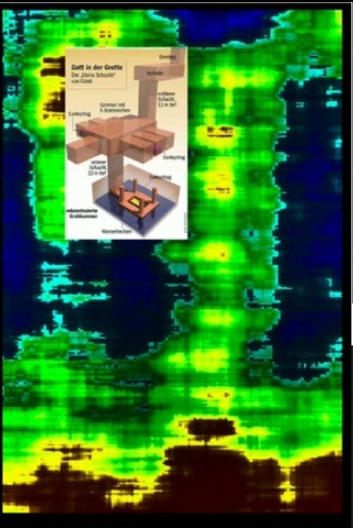
Figure 9: The OSIRIS SHAFT known structure in the left corner and SAR Doppler Tomography picture of the same structure, reveals previously unknown continuing shafts and chambers below (KRPSAR Technology, 2025).
|
When the team has concentrated on examining the Osiris Shaft using SAR Doppler Tomography method, they have found all the known structures (Fig. 9). However, there was a big surprise waiting for them: there was much more to the known structure. An unknown shaft was revealed below the known structure that kept leading deeper and revealing new chambers, which then revealed new shafts, which led to new chambers, and so on, down to the depth of 1.2 km.

Figure 10: Many shafts along the Khafre’s Causeway including the Osiris Shaft have been found to go deep into the bedrock, down to 1.2km (KRPSAR Technology, 2025).
|
In fact, many other shafts near the Causeway filled with sand remain unexplored have also been found to go deep into the bedrock to 1.2 km. In the Fig 10, we see the scanned area from the pyramid of Khafra to the Valley Temple, which is riddled with large and deep shafts cut into the bedrock and showcasing very straight vertical edges cut at 90° angle. One of the shafts showcasing a perfect straight cut is very much reminiscent of a lift cavity, Fig 11. This should not be surprising, as if you needed to descend to 1.2 km and come back, you would need a lift, and a fast one, for that matter.
Previous research done by the team before this discovery where they successfully used their SAR Doppler Tomography method also includes scanning active volcanoes.

Figure 11: One of the shafts at the Giza Plateau, reminiscent of a lift cavity with perfect straight edges (taken by author, 2023).
|
VALIDATION 3: SCANNING AND INTERPRETING VOLCANOES AND KNOWN UNDERGROUND STRUCTURES
In 2022 Biondi published his article titled ‘Scanning Inside Volcanoes with Synthetic Aperture Radar Echography Tomographic Doppler Imaging’ where he describes his imaging method based on the analysis of micro-motions generated by the Earth’s underground heat in volcanoes that enables transformation of the SAR images into the sound images and through tomography eventually into the 3D modelling of the underground structures. This was the first time SAR has been employed to investigate the consistency of the structures below ground to a depth of 3km. Biondi’s protocol results have mapped the magma chamber and main and secondary volcanic conduits inside the Vesuvius volcano with high-resolution imaging.
To validate the results, the SAR Doppler seismic tomography was compared to magneto-telluric tomography data obtained by the ‘in situ’ stations positioned on the ground in the proximity of Vesuvius at the time of SAR scanning. A good correlation was found between the seismic events marked by the ‘in situ’ sensors as earthquakes and SAR seismic tomography showing magma where they coincide in time, space, and depth. Therefore, the results obtained via SAR doppler tomography were validated by the same results obtained by the ‘in situ’ earthquake sensors (Fig. 12).

Figure 12: Vesuvius SAR Doppler Tomography pictures compared to the magneto-telluric tomography pictures align well (Biondi, 2022).
|
Before this work, Biondi used his SAR Doppler Tomography method to investigate other man-made large structures, such as the Mosul Dam in Iraq and the Gran Sasso physics laboratory in Italy, to evaluate ‘vibrations of large infrastructures, like huge bridges that can lead to early detection of cracks and therefore saving lives.’ The layout of Gran Sasso laboratory below the Gran Sasso Mountain is well known and served as a validation of the SAR Doppler Tomography method.
There are apparently only about 200 such specialists living at the moment who can understand and validate these results, and not one of them has negatively critiqued the findings.
FUNCTION AND AGE
Mei has stated that the age and function of the underground structures remain unknown at this stage. Malanga hinted, however that the structure may have functioned as a resonant instrument using water found underground, stone, and vibrations for healing purposes.
This recalls the findings of another researcher, an aerospace manufacturing engineer Cristopher Dunn who has laid out a theory of the Great Pyramid as an electron harvester, a machine perpetually producing clean energy to the civilisation that built it and maybe a solution to a world that is addicted to energy. Gamal Elfouly, an Egyptian scientist came independently to the same conclusion, i.e. the pyramids were not tombs but machines. Dr Sam Osmanagich, discoverer of Bosnian Pyramid Valley near town of Visocica, in Bosnia, is of the same opinion and is citing Nikola Tesla: ’All pyramids resonate at Earth’s Shuman resonance 7.8Hz, and since there is a running water under the structures that produces free negative ions, you have all conditions for a working energy machine.’
Indeed, looking under the pyramid of Khafre, at the wells engulfed by coils, they are very much reminiscent of so-called Tesla coils. In the last century, a flamboyant Croatian inventor the world is starting to re-discover, came up with many inventions, some of which we are still using today, every day. However, it is his electric resonant transformer that looks a lot like an underground well with a spiral wrapped around it, found by the Khafre Research Project SAR Technology team. You can still see Tesla’s coil invention at work today, if you go to the Tesla Museum in Belgrade, Serbia (Figure 12).

Considering the age of the structures on the Giza Plateau, it is interesting to point out couple of not so recent discoveries that went unnoticed. In 2014 Ioannis Liritzis, professor of archaeometry and natural sciences with PhD in physics have published dates of some of the Giza Plateau monuments using his own novel technique, called surface luminescence dating (SLD). This novel method is the only direct stone dating method that exists at present and should have made world news, but it didn’t as this discovery comes from someone who is also an ‘outsider’ the implications of which would shake the presently accepted model of history.
The technique involves counting electrons in a stone sample that was not exposed to the sun light since the time of stone’s dressing, i.e. its positioning into a structure it is a part of. Since solar radiation, both UV and optical spectrum constantly bleaches the electrons from the surface of a stone that is exposed to the sun light, down to a depth determined by the penetration of light in that material. The exposure to the light erases the electrons seen as luminescence, to a zero or near zero value. During construction the stone surface is covered, and electron accumulation starts again that arrives by cosmic bombardment and ambient radioactivity and continues till excavation or sampling. The trapped electrons are measured by stimulating the crystalline minerals in a stone such as limestone or granite, by heat (thermally) or visible light (optically). Electrons are released and emit luminescence in the UV and/or visible spectrum. This leads to the age when stone has been dressed and positioned; a radiation dose since the stone was dressed and placed in situ, divided by the annual dose rate for a particular stone, gives the age of the structure.
When the SLD technique was used on a couple of samples taken from the Osiris Shaft, the age was calculated to be around 3000 BCE, placing it about 500 years before the pharaonic age.
Similarly, after sampling the Pyramid of Menkaure and using the SLD method, the age was calculated to be 3450±950 BCE, a 1000 years earlier prior to the pharaonic age and possibly older.
Time and again, we see how the academia reacts when the new discoveries coming from an ‘outsider’ armed with a concrete scientific knowledge and undeniable data is crushing their pre-conceived view of the Darwinian history timeline pushing it much farther back in history. It does not matter if this ‘outsider’ is a scientist and inventor of the method he used to arrive at the results he announced. They are ignoring him, his novel method and the results in a hope they will be forgotten.
But, this time, the news is too large to be ignored or forgotten.
IMPLICATIONS AND WHAT COMES NEXT FOR THE TEAM
When the team looked at Giza’s wider perspective, they noticed many vertical and rectangular structures below all three pyramids going to 2 km depth. They decided to call it a city and planned to investigate it in depth. The results of this investigation are planned to be revealed to the public at their next conference in December.
Near the end of the conference, Malanga said: ‘One thing is for sure, the ancient Dynastic Egyptians did not build this structure. They did not have the tools. It is logical to expect the older structures the deeper we go into the ground. It is also logical that structures that are below ground precede the structures above, as that was the only way to build such complex. The ancient Egyptian Dynastic civilisation did not have the level of technology to dig this deep, so that is out of consideration.’
In the words of Mei: The structures that are found below the Giza ground level is the most compelling evidence of the existence of the previous technologically advanced culture.’ When asked to give an idea of the age of the structures deep underground, Mei has given a date between 70 - 75, 000 BP, quoting a cataclysmic volcanic eruption of Mount Toba, Sumatra around that time. This supervolcano eruption was the largest one in human history and almost caused the extinction of the human race. The survivors of the present highly technologically evolved civilisation known to us as Atlantis have fled to the land of Khemt (ancient Egypt) and restarted their civilisation. They are the ones who built the Giza Plateau monuments and substructures.
The theory that pyramids were built as tombs has just been buried. As Elfouly has expressed: ‘The pyramid as tomb theory is an insult on human intelligence, after findings of such precision and workmanship that cannot be duplicated today. Consequently, this means that builders possessed an unknown technology more advanced than ours. This is the reality, whether we like it or not.’
Once the dust has settled from the initial scepticism regarding the team’s novel method and their international SAR Doppler Tomography invention application is approved, the world will have no choice but to accept the facts. The implications will be huge. The questions of who, why, when, and how was this megacomplex built will be staring us in the face.
When asked what was next on their agenda, the team replied after they finish investigating the Giza Plateau, they will be looking at the Serapeum underground structure in Saqqara, a Pyramid of the Sun in Mexico and Cydonia region on Mars. Cydonia region is known to contain massive pyramidal and other structures such as the one called ‘Face’, all pointing to the extinct ancient Martian culture remains.
Now, that sounds seriously exciting, as it seems we are entering an age of xenoarchaeology and we don’t even have to go to Mars to dig, since Mars has its own artificial satellite in orbit and has been extracting information from the surface for some time. Sky is the limit, or maybe it isn’t in this case. This is an interplanetary project in their own words ‘for all mankind and possibly Martians too’. It seems the pyramids, as one of the oldest mysteries of our civilisation, will finally give up their secrets. Acceptance of the discovery will mark the beginning of a new era, where technology reveals what eyes cannot see. We need to stop ignoring it and start discovering our real history.
REFERENCES
Biondi, F. Scanning Inside Volcanoes with Synthetic Aperture Radar Echography Tomographic Doppler Imaging. Remote Sens. 2022, 14, 3828. https://doi.org/10.3390/rs14153828
Biondi, F.; Malanga, C. Synthetic Aperture Radar Doppler Tomography Reveals Details of Undiscovered High-Resolution Internal Structure of the Great Pyramid of Giza. Remote Sens. 2022, 14, 5231. https://doi.org/10.3390/rs14205231
Biondi, F., Malanga, C. & Mei, A., 2025, ‘Conference: #Giza The pyramids and the Temporal Gateway. Armando Mei, Filippo Biondi, Corrado Malanga’, Expedition, Ciccolo, N., YouTube, https://www.youtube.com/watch?v=qop3jd9qL9E Accessed 27/04/2025.
Britanica, Mount Toba, https://www.britannica.com/place/Mount-Toba, Accessed 1/05/2025.
Britanica, Zahi Hawass, https://www.britannica.com/biography/Zahi-Hawass, Accessed 1/05/2025.
Dunn, C., 2024, ‘GIZA: The Tesla Connection’, Bear & Company, Rochester, Vermont, USA.
Gellert, M., 2025, Techsite, Tesla Coil – Animated Schematic, https://techsight.co/index.php/2023/07/27/tesla-coil-animated-schematic/ Accessed 29/03/2025.
Grassi, T., 2025, The Biondi Protocol: Revealing the Megachambers Below Giza, with Filippo Biondi and Armando Mei, YouTube, https://www.youtube.com/watch?v=OK3bjfxLM9s Accessed 27/04/2025.
Khafre Research Project SAR Technology, Official FB page of The Khafre Research Project SAR Technology (Italy), Facebook, https://www.facebook.com/KhafreResearchProjectSARTechnology Accessed 27/04/2025.
Liritzis, I., & Vafiadou, A., 2015, ‘Surface luminescence dating of some Egyptian monuments’, Journal of Cultural Heritage, Volume 16, Issue 2, pp 134-150, https://doi.org/10.1016/j.culher.2014.05.007 Accessed 03/05/2025.
Malanga C., Mei A. & Biondi F., 2025, Abstract conf. English Version (3), ‘Giza The Pyramids and the Temporal Gateway’, Press Conference, Bologna, Italy, Scribd, https://www.scribd.com/document/843169853/Abstract-conf-English-Version-3 Accessed 24/04/25.
Old Worlds & New Worlds, 2025, ‘Revolutionary discovery! What is hidden under Giza pyramids? Podcast with dr. Sam Osmanagich’, YouTube, Oldworldstours.com, https://www.youtube.com/watch?v=2S2_W7QPj6k Accessed 03/05/2025.
Pasteka R., et all, 2022, Journal of Archaeological Science: Reports, ‘The discovery of the “muons-chamber” in the Great pyramid; could high-precision microgravimetry also map the chamber?’, volume 43, https://doi.org/10.1016/j.jasrep.2022.103464 Accessed 02/04/2025.
Project Unity, 2025, ‘EXCLUSIVE: Meet The Scientist Behind The MASSIVE Giza Plateau Discoveries!’, YouTube, https://www.youtube.com/watch?v=b513P5g7XmQ Accessed 26/04/2025.
Scimex, 2023, ‘Cosmic radiation reveals the hidden insides of the Great Pyramid of Giza’, https://www.scimex.org/newsfeed/cosmic-radiation-reveals-the-hidden-insides-of-the-great-pyramid-of-giza Accessed 05/05/2025.
Temple, R., 2010, 'Egyptian Dawn Exposing the Real Truth Behind Ancient Egypt', Century, London, Great Britain.


Comments